 SENTINEL
What Does a Cheap Meal Cost Us? · Chapter One
The Hands That Feed Us
Immigration raids are emptying America's fields and packing plants — and the government is letting the ones that remain run faster, with fewer inspectors.
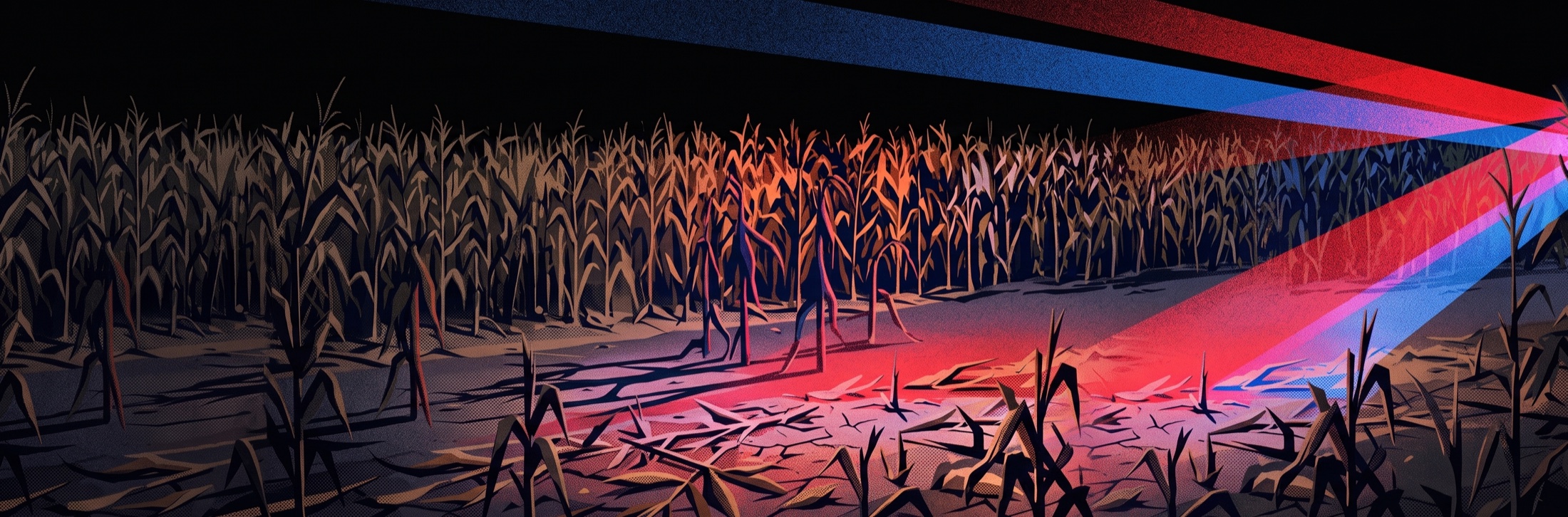
Between March and July 2025, the United States lost 155,000 farm laborers1 — a 6.5 percent drop in four months, on federal data compiled by the American Enterprise Institute. Roughly 40 percent2 of the country's two million crop workers are undocumented, and as the raids spread through farm country the openings went unfilled. Growers across California reported that as many as 70 percent of their workers had stopped coming in3; some farms ran at a third of capacity, and restaurants in Los Angeles closed early for lack of staff. The scars did not heal with the season — a year on, farmers were still describing a workforce that would not come to work.
Farmworkers described a community that had stopped moving. “One wakes up in the morning in fear, because many of us will leave our house and probably won't come back,” one told a Los Angeles television crew4; “many do, others do not.” Two others told Newsweek5: “We are so paranoid. You're afraid to go out on the street. We only go out to the basics,” and, “There is no sense of normality anymore.”
American food is cheap in part because the people who grow and cut it are paid little and, being undocumented, are in no position to demand more. Take that labor away and the cost has to move — a warning that came not from the workers' advocates but from the administration's own Labor Department6. In an interim rule issued on October 2, 20257, the department wrote that “the near total cessation of the inflow of illegal aliens,” combined with “increased enforcement,” posed “a sufficient risk of supply shock-induced food shortages” and threatened “the stability of domestic food production and prices for U.S. consumers.” The same rule lowered the wages8 those farmworkers are guaranteed. For now the shock is a forecast, not a receipt: grocery prices rose a routine 2.7 percent9 in the year to May 2026, and no one has traced a measurable increase to the raids.
The administration has conceded the shortage without closing it. Its main legal channel, the H-2A visa10, covers only seasonal work and excludes year-round operations like dairy, so it cannot backfill the missing hands. A new Office of Immigration Policy11, created inside the Labor Department in June 2025 to speed farmers' access to temporary visas, had produced little relief months later. By early 2026 officials were admitting outright that they needed immigrant farmworkers even as the wage rule cut their pay — a contradiction the United Farm Workers took to court in March 202612, and that the American Farm Bureau, that year, was calling the single greatest threat facing American agriculture.
The enforcement only widened. After the White House set a target of 3,000 arrests a day13 in late May 2025, agents moved from the fields to the worksites — packing houses in California, and on June 10, 2025, the Glenn Valley Foods plant in Omaha14, where 76 people were arrested in what Nebraska officials called the state's largest worksite operation. On September 4, 202515, federal agents detained roughly 475 workers at a Hyundai battery plant under construction in Georgia — the largest single-site immigration raid in the history of Homeland Security Investigations. Worksite enforcement, the border czar Tom Homan promised that June, would “massively expand.”16 It did not, quite: by mid-2026 the administration was privately conceding17 that worksite enforcement “isn't happening” at the scale its deportation targets required, and the marquee raids had slowed. What expanded instead was the paperwork — audits of employers' hiring records rose roughly eightfold18 early in 2026 — and the fear, which needs no raid to work.
What the crackdown does to the safety of the food, as distinct from its supply, turns on how the work changes when the workforce thins. Meatpacking is among the most dangerous jobs in the country — the industry recorded 946 amputations between 2015 and 202419, more than any other in manufacturing — and it runs fast to hold costs down. A plant short of experienced hands fills the gap through staffing agencies, temporary workers who, by the UCLA Labor Center's account20 of Los Angeles processing plants, often reach the line with little or no training.
The reliance is old. Meatpacking has drawn on immigrant labor since the Chicago stockyards of the last century, and on undocumented workers in particular for decades: about a third of the workforce is foreign-born21, and an estimated 23 percent is undocumented22. What changed is the churn. Where stable union jobs once anchored the big plants, much of the work now moves through staffing agencies23, hired fast and replaced faster.
Into that thinning workforce, the government is moving to let the lines run faster. After announcing the effort in March 202524, the Agriculture Department published proposed rules in February 202625 — comments closed that April — to raise slaughter speeds to 175 birds a minute at eligible chicken plants and to let pork plants set their own pace under a “process control” standard, while dropping a requirement that plants file worker-safety data, on the claim that speed and injury are unrelated. It is doing so with fewer people watching: the Food Safety and Inspection Service has shed about a tenth of its staff26 since the 2025 fiscal year began, inspectors most of all. “To put it simply,” said Paula Schelling-Soldner27, who leads the inspectors' union, “the plant will control every aspect of it with minimal oversight.” The department says faster lines are safe and points to a USDA study28 — which measured injuries to workers' bodies, not the cleanliness of the meat.
Fear sits over all of it. Advocates who work with plant employees say a workforce afraid of deportation is less likely to flag a fouled line29 or a broken cold chain, because to be noticed at all is to risk being taken.
The market that food feeds into is tightening on its own. American beef hit record highs in 2026 — ground beef near $6.90 a pound30 in April, the cattle herd the smallest since 195131, squeezed by drought and by a screwworm outbreak32 that shut the southern border to Mexican cattle for more than a year and, by June 2026, had crossed into Texas. The four companies that slaughter 85 percent of the nation's beef33 — a concentration the White House itself cited in November 2025 while opening a price-fixing inquiry — answer less to American ranchers than to distant owners: JBS34, listed in New York in June 2025 but controlled by Brazil's Batista family; Smithfield, the pork giant owned by China's WH Group35; Tyson, run through the founding family's super-voting shares. These are among the firms lobbying, successfully, to run the lines faster and file less.
Whether any of this has already pushed contaminated meat toward a kitchen is a quieter question, and the data lag. In 2024, the number of people hospitalized or killed in tracked food-outbreak investigations roughly doubled36; a Listeria outbreak traced to prepared pasta meals killed six people across eighteen states in 2025. The crackdown did not begin that slide.
The fields will be picked and the lines will run, by fewer and newer hands moving quicker than they can safely be watched. What leaves the plant travels the same as ever — the boxed chicken, the ground beef. The people positioned to catch what a thinner, frightened workforce misses are the inspectors and food scientists of the FSIS and the FDA, and they are being cut too: the FSIS is down about 900 employees37, inspectors above all, even as it moves to speed the lines; the FDA has shed nearly 3,90038, including 89 from its human-foods program39 in a February 2025 purge that drove its first food-safety chief to resign. The law says a slaughter line cannot run without a federal inspector40 standing on it. There are fewer of them every month.